Monday, April 27, 2015
My "blue" thumb
 9:08 PM |
 Posted by
Kaplan Center for Health and Wellness
By: Jeanette Andrade PhD, RDN, LDN

My husband has a green thumb. He graduated with a bachelor’s in
agricultural engineering, so he knows how to grow plants, what to do, etc. I
follow his directions, but what happens? The plant dies. Every single year this
happens. For example, my dad gave me a cactus when I got my first job as he
said I would not kill this thing, well I did. It survived 3 months. I do,
however, grow weeds very well as was seen last year. I planted some wild
flowers as I thought those couldn’t possibly die, but they did, however, the
weeds survived! So, I have what is called a “blue” thumb or at least that is
what I call it. I mean how else could this happen year end and year out? I
don’t like blaming genetics, but I really think my mom passed this “blue” thumb
thing onto me. She never could grow plants at all. The only plants that
survived her thumb were the ones she despised. You may ask how one can despise
plants. Well, she was given a house plant by my grandmother for Mother’s Day.
It wasn’t the prettiest house plant in the world, but that thing survived. I
mean weeks went by where we forgot to water it or give it plant food, but it
continued to grow. It seriously was like the plant from “The Little Shop of
Horrors” movie. We even named the plant Audrey III. I think my mom finally gave
it away at work, but it stayed in our home for over 5 years.
I appreciate when I tell people that I am not a gardener and explain my
situation that they become sympathetic and start advising me on how I can
become a better gardener. However, I am content with the fact I have a “blue”
thumb. And that I am a manager of the garden and tell my husband where the
plants should go. Even though he puts them someplace else as he knows what will
grow best where.
I will say this, 5 years ago I went against all advice given to me by
my husband and others and planted my tree, the “Japanese Evergreen”. Literally
my secret was digging a big hole, carefully dropping the tree in, watering it,
and then telling the tree he better grow. Who knows? This tree could become
Audrey IV….


Friday, April 24, 2015
National Center for Complementary and Integrative Health - New Name, Fresh Look
4:47 PM |
Posted by
Kaplan Center for Health and Wellness
A Long-Time CAM Supporter Takes a Timely Look at the ‘Mushy’
Vocabulary of Complementary and Alternative Medicine
On the
occasion of the name change at the National Institutes of Health, I have found
it necessary to provide some background into the terminology that current
exists in the courses I teach and the larger world I inhabit. Many of my students find the CAM terminology
to be confusing. Often, they are fully
aware of the perspectives of mainstream medicine but unaware of what CAM is and
where it is going. Indeed, logical minds
are not comfortable with the constantly changing, "mushy" terms of
CAM. Given the conceptual differences between CAM and mainstream
medicine, and their competition for influence in our culture and economy, one will
not find permanent precision and absolute clarity. It is more of a process of jumping in and
feeling your way around.
In order to understand the vocabulary of CAM, I think it is important to note that there was really no such thing as CAM until the very late 1900’s, when it was referred to as “Alternative Medicine.” According to the NCCIH website1, in 1991, an office was established in the National Institutes of Health to collect information on promising, unconventional therapies that were in use in order to begin evaluating whether any of them had potential benefits. In 1993, that office became the Office of Alternative Medicine (OAM).
In 1998, OAM was elevated to the status of a Center within the National Institutes of Health and the name was changed to the National Center for Complementary and Alternative Medicine (NCCAM). To me, that move represented progress in the process of bringing CAM into the realm of respectability within the medical community. The addition of the word, “complementary” furthered the notion that even a conservative physician could recommend a CAM practice to a patient when it appeared to be reasonable and helpful.
It was
no longer a battle between Mainstream and Alternative Medicine, which in the
1970’s had led to a U.S. District Court ruling (the U.S. Court of Appeals
affirmed and the U.S. Supreme Court declined to review the case) forcing the
American Medical Association to stop trying to destroy Chiropractic.3 That
case made it clear that there were limits on how mainstream medicine (e.g., the
once powerful AMA – the American Medical Association) could limit individual
access to practices that the public found useful and appealing. Since the AMA was unable to prove that
Chiropractic was a fraud and ineffective, the stage was set for expanded State
licensing of non-mainstream health practices and the growth of more practices
that might eventually find their way into mainstream society and medicine.
In
November of 2014, the name of NCCAM was changed to the "National Center
for Complementary and Integrative Health" (NCCIH). This change brings clearer recognition of a truce
between mainstream medicine and at least those practices that have received
validation through the process of mainstream scientific research.
CAM is an umbrella term (concept) that was developed to include all of the medical and health practices that exist which do not fall into the accepted confines of mainstream, conventional, allopathic medicine. Clearly, this is a mixed bag, with some practices having substantial scientific validation and other practices having none. Therefore, what one person considers CAM may be considered “quackery” to another person and mainstream medicine to yet another individual. It all depends upon one’s perspective.
To
further confuse things, there is also no such thing as mainstream medicine,
either. There is no clear cut way to describe all of mainstream medicine,
other than to include everything commonly taught in medical schools and
reimbursed by insurance companies. Such
a broad term, of course, has many exceptions and mainstream medicine includes
many thousands of practices that are unproven and still in stages of
development and research. Mainstream
Medicine is, therefore, just a rough, collective term for the diverse, but generally
accepted, practices, in western medicine today.
An earlier edition of Micozzi’s groundbreaking textbook on CAM2 was named “Fundamentals of Complementary and Integrative Medicine.” Perhaps the author and Publisher were anticipating a change in terminology or perhaps they were hoping to trigger such a change. The various names (complementary, alternative and integrative) have different intentions and meanings, depending upon the context.
Currently, I think that the recent change to "Integrative Health" (NCCIH) is probably motivated to work around the resistance of mainstream medicine to the term "Alternative” medicine. It is also driven by a desire to avoid opposition from mainstream doctors who don't like the term "Medicine" being used for something that is not mainstream medicine, and even practiced by non-M.D.’s. Doctors often assert that only M.D.'s (and D.O.'s) are able to legally practice Medicine and that therefore nobody else should use that term. Thus, we may have just witnessed an important negotiated settlement making it easier for un-researched modalities to be studied by mainstream researchers.
An earlier edition of Micozzi’s groundbreaking textbook on CAM2 was named “Fundamentals of Complementary and Integrative Medicine.” Perhaps the author and Publisher were anticipating a change in terminology or perhaps they were hoping to trigger such a change. The various names (complementary, alternative and integrative) have different intentions and meanings, depending upon the context.
Currently, I think that the recent change to "Integrative Health" (NCCIH) is probably motivated to work around the resistance of mainstream medicine to the term "Alternative” medicine. It is also driven by a desire to avoid opposition from mainstream doctors who don't like the term "Medicine" being used for something that is not mainstream medicine, and even practiced by non-M.D.’s. Doctors often assert that only M.D.'s (and D.O.'s) are able to legally practice Medicine and that therefore nobody else should use that term. Thus, we may have just witnessed an important negotiated settlement making it easier for un-researched modalities to be studied by mainstream researchers.
Words
such as therapy and practice are among other choices for describing
not-specifically-medical interventions. Perhaps the safest way to carve
out different approaches to health and wellness is to put them outside the
domain of “medicine” and into “health.”
Some will see this as mere politics and public relations, but this is
the medico-legal world in which we live, and in which practitioners seek the
freedom to practice in ways that are meaningful and successful to them.
Physicians are technically free to use or recommend complementary and
integrative therapies to the extent that organized medical societies don’t
decide that they have endangered patients and the reputation of medicine.
In the bigger picture, I think that mainstream doctors sometimes take defensive postures against unconventional practices out of concern for patients, but also to confront serious challenges to mainstream medicine orthodoxy. Instead of the reductionist “Disease Model”, many consumers, health practitioners and physicians are in favor of a holistic “Health and Wellness Model”. In the midst of this change, transformation and struggle, here is my understanding of the differences between the different terms:
In the bigger picture, I think that mainstream doctors sometimes take defensive postures against unconventional practices out of concern for patients, but also to confront serious challenges to mainstream medicine orthodoxy. Instead of the reductionist “Disease Model”, many consumers, health practitioners and physicians are in favor of a holistic “Health and Wellness Model”. In the midst of this change, transformation and struggle, here is my understanding of the differences between the different terms:
Underlying the confusion
with the various terms is the fact that these terms apply to how a given
practice is used, rather than anything inherent about the practice,
itself. Therefore, if someone treats
cancer by using acupuncture and herbs, and avoiding standard medical
treatments, that is an “Alternative Medicine.”
If someone uses acupuncture and herbs in addition to standard medical
treatments, that is “Complementary” or “Integrative,” depending upon the
scientific basis in the treatment.
So, a treatment plan is
“Mainstream” if it relies solely upon mainstream medicine. It is “Complementary” if it relies upon both
mainstream and other practices that have some credibility. The treatment plan is “Integrative” if it
relies upon mainstream and other practices that have a scientific basis. It is “Alternative Medicine” if the treatment
plan has no scientific basis and avoids all mainstream medicine.
Hierarchy of Acceptance and Scientific
Validation
of Medical and Health Practices
1. Mainstream Medicine requires scientific proof of relative
safety and efficacy unless grandfathered in as standard practice. Note
that half of mainstream medicine practices are not validated by clinical
research studies.
2. Integrative Medicine requires some scientific evidence of
safety and efficacy, but not mainstream acceptance.
3. Complementary Medicine (or Complementary Health practices)
requires some general evidence of safety and the willingness of doctors to try
it, but does not require mainstream acceptance.
4. Alternative Medicine requires no scientific evidence of any
kind and is generally rejected by mainstream medicine. In a way, anything
goes, since Alternative Medicine also entirely rejects mainstream medicine.
Some doctors use some Alternative Medicine practices as complementary or integrative,
however.
5. Traditional Medicine practices are ancient/aboriginal practices
that are “Alternative”, but may be used at times as Complementary or
Integrative if a doctor thinks it is appropriate.
The state
of the various CAM terms is in constant flux. Therefore, if you are
certain that you understand the precise meanings of all of these terms, you are
probably wrong. Instead, I'd suggest approaching these terms as dynamic,
evolving and used by different parties in different ways. It is important not to overlook that there is
an ongoing, historical process of upheaval in the conceptual base of our health
care system.
Notes
2Micozzi,
Marc S., Fundamentals of Complementary and Integrative Medicine, Third Edition,
Saunders/Elsevier, 2006.
3Wilk v. American Medical Association, 895 F.2d 352 (7th Cir. 1990).
The case was affirmed by the 7th Circuit U.S. Court of
Appeals and review was declined three times by the U.S. Supreme Court.
4According
to their website, “At Duke Integrative Medicine, you experience a new approach to medical
care that brings you and your provider together in a dynamic partnership
dedicated to optimizing your health and healing. Our approach
focuses on all of who you are, recognizing that the subtle interactions of
mind, body, spirit and community have a direct impact on your vitality and
well-being.” http://www.dukeintegrativemedicine.org/, retrieved 3/25/2015.
Earon S. Davis has been involved with the world
of Alternative Medicine, CAM/CIH since the late 1970’s. He has a master’s degree in public health from UCLA and a law degree from Washington University. Earon has had careers in law, environmental
regulation, health advocacy, nonprofit management, massage and bodywork, and
university teaching, along with awards and recognitions.
Currently, Earon is a full-time adjunct faculty
at Kaplan University’s School
of Health Sciences, in the Health and Wellness
Department, where he
teaches courses on CAM, Stress Management and the
Capstone course
in the undergraduate Health and Wellness bachelor’s
degree program.
Would you like some honey with that?
8:41 AM |
Posted by
Kaplan Center for Health and Wellness
By: Jeanette Andrade, PhD, RDN, LDN


I am not a big honey fan. I don’t know why, I know there are health
benefits associated with honey, but I don’t really use honey much on anything. Well,
I don’t eat a lot of table sugar either as I am not a sweet fan. On the other
hand, my daughter and husband use honey as if it is going out of style. They
add honey to their oatmeal, Cheerios, bread, and even sometimes a fresh fruit
shake. Many of my clients, especially my active clients, use honey as an energy
booster. So, I decided to investigate more about honey and share my findings.
Many know that honey is made from bees, but the entire process of how
bees make honey is quite fascinating. First, bees do all the work of extracting
the nectar from flowers and place this nectar into the honeycombs. Second,
beekeepers collect the honeycomb frames and scrap off the wax cap that seals
the honey into these combs. After the wax caps are removed the frames are
placed in an extractor to remove the honey from these combs. Once the honey is
extracted, it is strained to remove any wax and particles. The process is
natural and there are no added preservatives or colors added (National Honey
Board, 2015). Note, different plants will produce different flavors and
possibly color of honey, but this does not mean a beekeeper altered the pure
honey (National Honey Board, 2015).
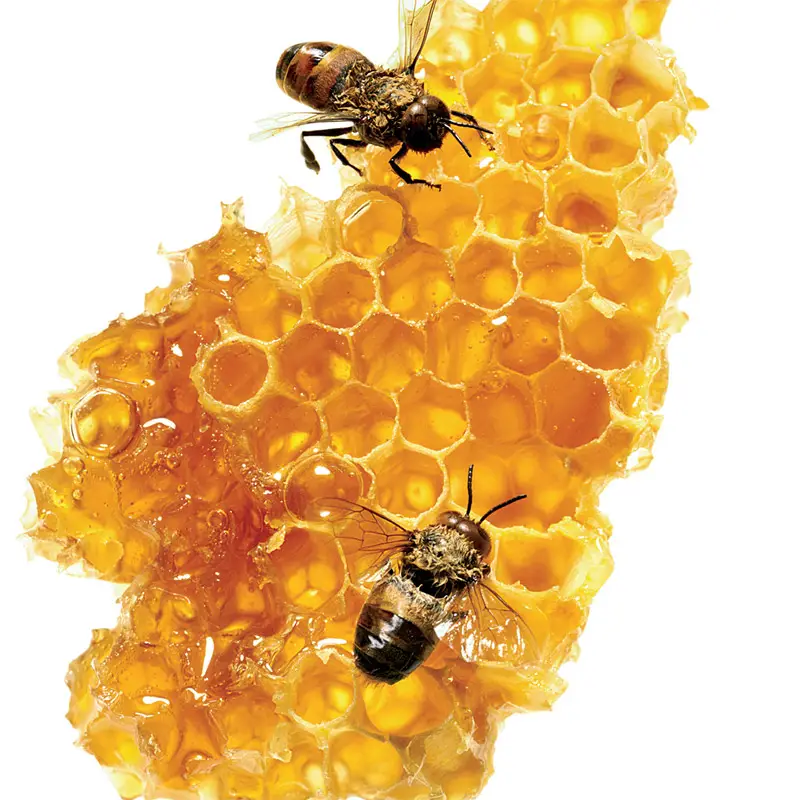
The natural process of making honey is very appealing to many, but
beyond the naturalness of honey, there are several health benefits as well.
Honey may help soothe a person’s throat (I do sometimes use honey for this),
help heal wounds and sores (however, seek medical attention if you do have a
wound or sore as the physician will know best how you should treat the wound or
sore), and possibly help fight infections (again check with your physician
prior to taking honey to reduce the infection) (Ware, 2014).
In a serving of honey (1 tablespoon) there is about 65 calories and 17
grams of carbohydrates. Additionally, honey may contain certain B-vitamins such
as b6, thiamine, niacin, riboflavin, and pantothenic acid, and other minerals
like calcium, iron, and magnesium. However, the amount of these nutrients will
depend on the type of plant that was used to make this honey (Dickinson, 2013).
If you are a honey fan or would like to incorporate honey more into
your diet, this recipe may help get you started:
Spinach Salad with Honey
Dressing and Honeyed Pecans (Retrieved from Southern Living)- Makes 6-8
servings
Ingredients:
1 (6-oz.) package baby spinach
1 cup quartered fresh strawberries
1/2 cup thinly sliced red onion
1/2 cup fresh blueberries
Honey Dressing*
3 to 4 cooked bacon slices, crumbled
1/4 cup crumbled blue cheese
Honeyed Pecans**
Preparation:
Toss together first 4 ingredients and 1/3 cup dressing. Sprinkle with
bacon, cheese, and pecans. Serve with remaining dressing.
Honey Dressing*
Ingredients:
1/3 cup white balsamic vinegar
2 tablespoons honey
1 tablespoon Dijon mustard
1/2 teaspoon salt
1/2 teaspoon black pepper
2/3 cup extra virgin olive oil
Preparation:
Whisk together vinegar, honey, Dijon mustard, salt, and pepper. Add
olive oil in a slow, steady stream, whisking constantly until smooth.
Honey Pecans**
Ingredients:
1/4 cup honey
1 cup pecan halves
Parchment paper
Cooking spray
1 tablespoon sugar
1/4 teaspoon kosher salt
Pinch of ground red pepper
Preparation:
Preheat oven to 325°. Microwave honey in a bowl at HIGH 20 seconds. Stir
in pecan halves. Coat a parchment paper-lined jelly-roll pan with cooking
spray; spread pecans in a single layer on pan. Combine sugar, salt, and a pinch
of ground red pepper; sprinkle over pecans. Bake 15 minutes or until toasted,
stirring after 8 minutes. Cool completely; break into pieces.
Subscribe to:
Posts (Atom)