Saturday, April 30, 2011
What's Your Favorite Nutty Butter?
 8:02 AM |
  Posted by
Kaplan Center for Health and Wellness
Posted by
Kaplan Center for Health and Wellness
by Lisa Beach, Ph.D.
Did you know that peanuts contain a cancer-causing toxin called aflatoxin? It’s a kind of mold, and it is found in all peanuts. It can be kind of upsetting to find out that things we’ve been doing for a long time (or things we grew up with) are not necessarily exactly what we thought they were. It’s true that peanuts may not kill you, and I’m not saying they will for sure anyway (there are other variables involved…you don’t want me to start on that here!)—but it’s a good idea to add some variety since we do know for sure that this toxin exists and has a link to cancer.
I don’t see this as the only reason to stay away from peanuts—-other nuts make perfectly delicious butters too! The awareness along with the deliciousness is why I recently conducted a Nut Butter Taste Test.
We tasted:
Dark Chocolate Almond
Almond
Cashew
Sunflower Seed
Macadamia
Almond
Cashew
Sunflower Seed
Macadamia
The one tasting most like peanut butter was the Sunflower Seed (Sunbutter) variety. Women were most likely to like the Dark Chocolate Almond the best (but the guys generally liked it too), and the overall general consensus was that Almond Butter was really good (I happen to like the Dark Chocolate Almond with the Almond Butter together—-smooshed into a sandwich with two crackers). Only one person liked the macadamia butter—it was really runny and didn’t have a lot of flavor. The cashew butter had a few more fans, but it was definitely second to worst according to my friendly tasters!
The crackers we used as delivery vehicles for the nutty butters were mini stone ground wheat crackers (no high fructose corn syrup or hydrogenated oils).
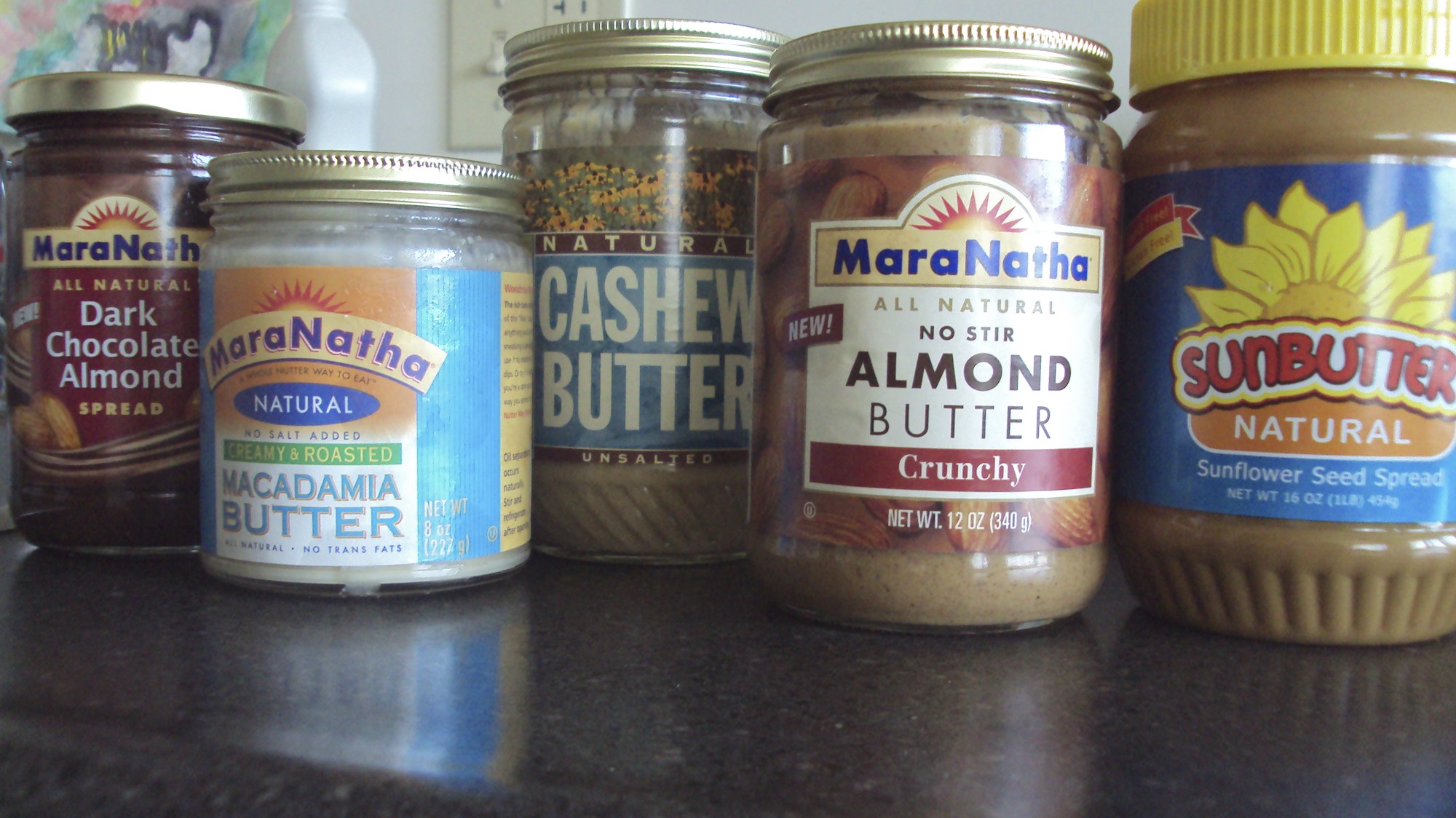
The Chosen Ones
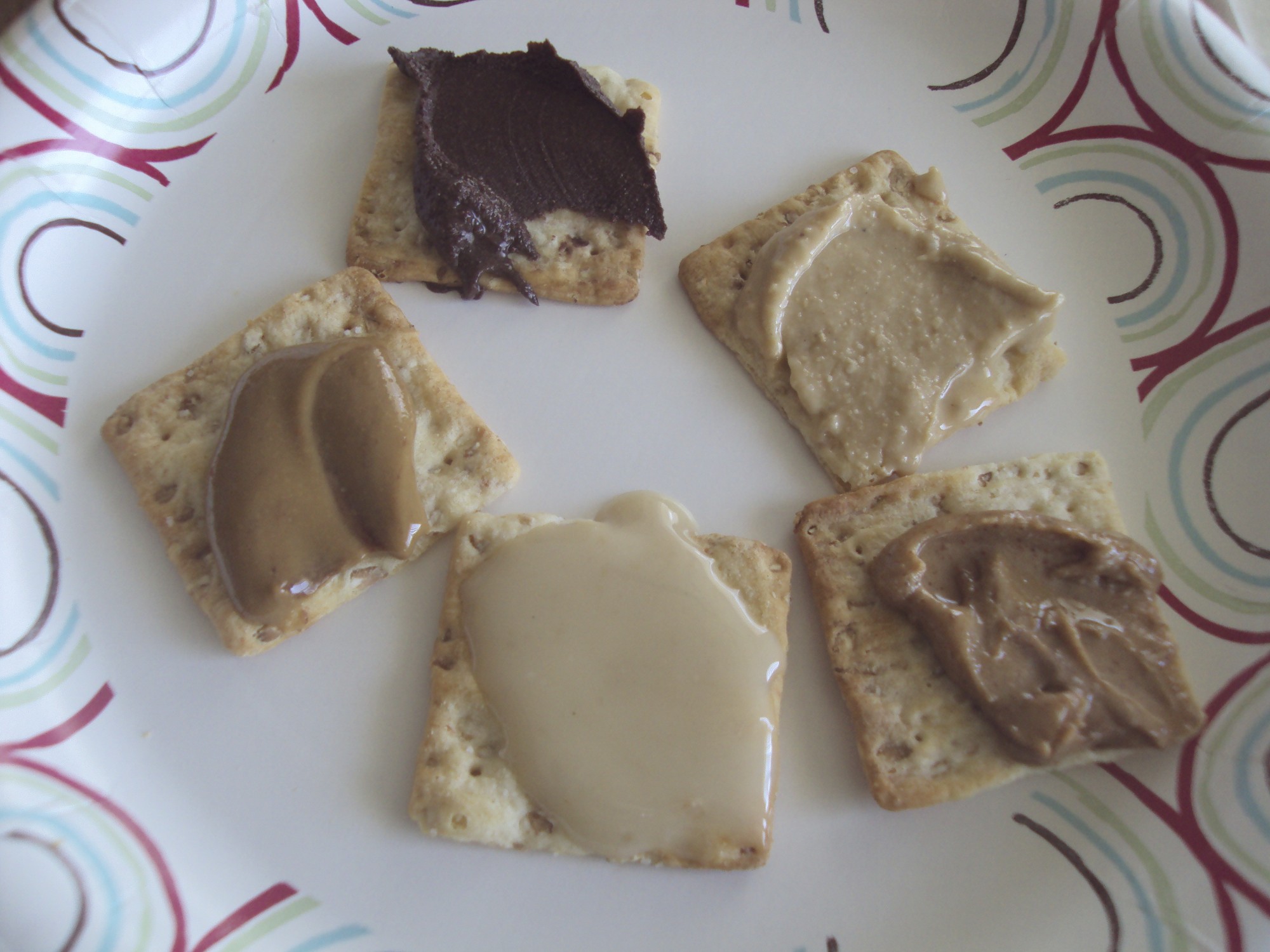
Clockwise from the top: Dark Choc Almond, Cashew, Almond, Macadamia, Sunflower Seed


Thursday, April 28, 2011
PB & J Smoothie...but Hold the PB & J!
4:53 PM |
Posted by
Kaplan Center for Health and Wellness
by Lisa Beach, Ph.D.
Along with my passion for ice cream, my blender, and more recently, for brewing kombucha…I am equally enamored with sunflower seed butter. I stay away from peanut butter due to the high mold content (aflatoxins—cancer causing mold in peanuts), and sunflower seed butter is the closest-tasting nut/seed butter to peanut butter. That said, my eye is constantly on Wild Jungle Peanut Butter online, which is made from heirloom peanuts said to be lower in mold. I bought some jungle peanuts online—they’re so pretty with their tiger stripes (I’m a sucker for pretty packaging and attractive unique products) that I don't want to grind them into "butter!"
Along with my passion for ice cream, my blender, and more recently, for brewing kombucha…I am equally enamored with sunflower seed butter. I stay away from peanut butter due to the high mold content (aflatoxins—cancer causing mold in peanuts), and sunflower seed butter is the closest-tasting nut/seed butter to peanut butter. That said, my eye is constantly on Wild Jungle Peanut Butter online, which is made from heirloom peanuts said to be lower in mold. I bought some jungle peanuts online—they’re so pretty with their tiger stripes (I’m a sucker for pretty packaging and attractive unique products) that I don't want to grind them into "butter!"
This week, I’m trying to use what I have in my kitchen—and this means my smoothies may be a extra weird creative for the rest of the week. I am always tempted to be creative (and considered putting figs and avocado together yesterday), but I also like to keep it simple.
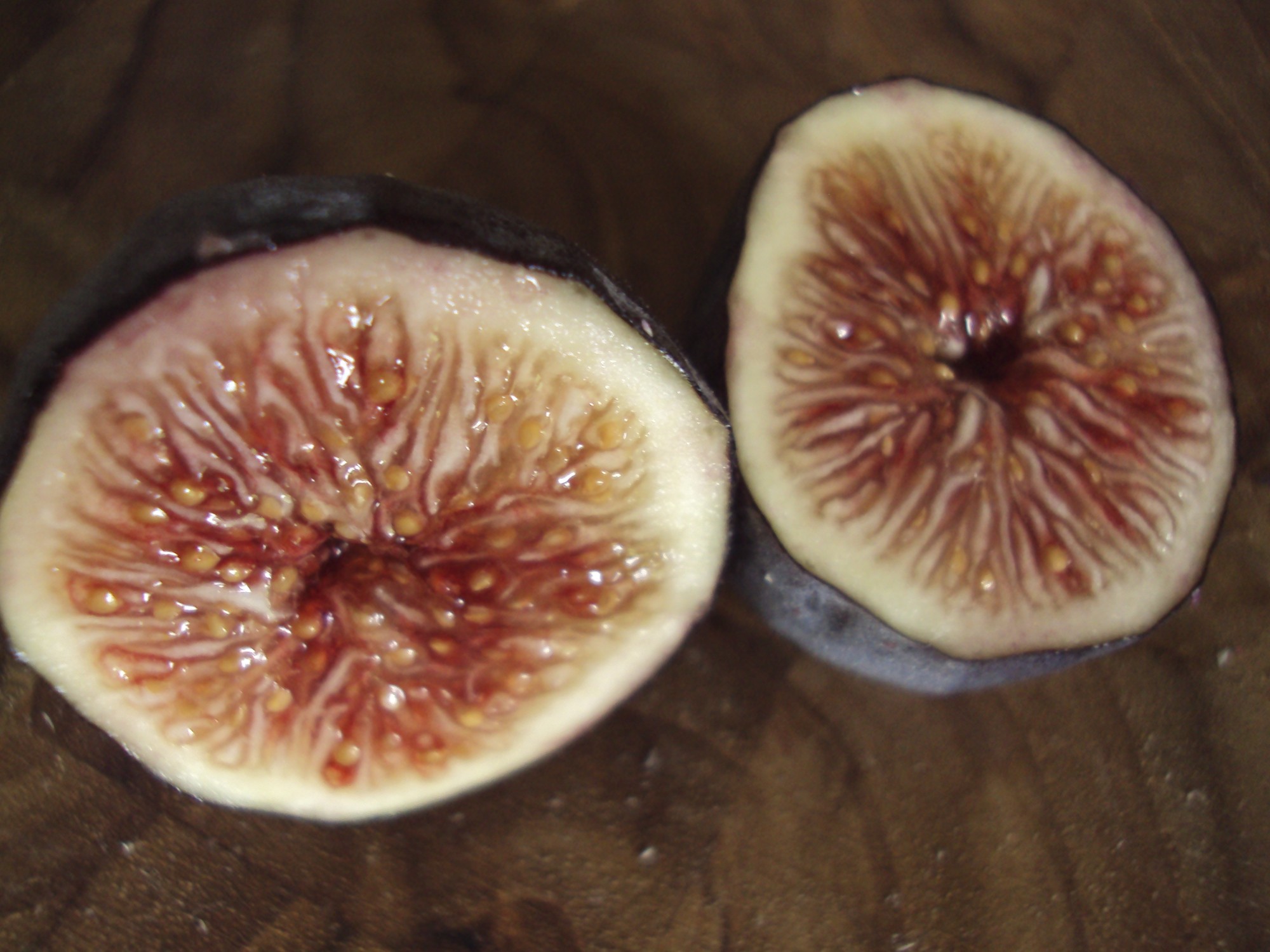
Figs---way better like this than their processed fig newton counterparts, so if that's your only experience with figs you're missing out!

Un-PB&J Smoothie: 4 figs, huge scoop of sun butter, 1 cup water, optional: 1/2 scoop sun warrior protein powder, 1 tbsp maca, 1 tbsp lucuma, 1 tbsp yacon. 1/2 tsp guar gum. Blend till smooth. Add 8 ice cubes or more. I ate this with a spoon, but it was more straw drinkable.
Why figs instead of jelly? Figs are high in fiber and iron, not to mention various other vitamins and minerals. The smoothie was a pale purple color with flecks of dark purple—it’s as delicious as it looks!
What's your weirdest smoothie combo?!
Sunday, April 17, 2011
The World’s Healthiest Foods
12:39 AM |
Posted by
Kaplan Center for Health and Wellness
Continuing on with my favorite websites series…
Here’s another great one: The World’s Healthiest Foods: http://whfoods.org/
This is a non-profit organization dedicated to sharing information about the health benefits of foods, recipes, cooking lessons, eating plans, and so much more…
Need some recipe ideas?

Click here: http://whfoods.org/recipestoc.php#recipes
How about some cooking tips?

Click here: http://whfoods.org/cookdemo.php
Would you like some advice about the nutrients in your diet?

Click here and answer the questionnaire: http://whfoods.org/foodadvisor.php
How about a 7-day-a-week healthy eating plan with recipes to boot? Click here: http://whfoods.org/hwep.php
I love this website. I think it is an easy way to get on the track to eating healthfully. I hope you find it useful too!
Nancy Silva, ND
Faculty, Health and Wellness Department
Wednesday, April 13, 2011
Local Harvest
6:55 PM |
Posted by
Kaplan Center for Health and Wellness
This week I’d like to continue with my favorite websites series…
Today let’s focus on Local Harvest: http://www.localharvest.org/
This site is dedicated to promoting small family farms. They have thousands of listings for small farms all across the nation!
Want to find out where small farms are located in your neighborhood?

Simply click here and put in your zip code: http://www.localharvest.org/organic-farms/
Need to find a farmer’s market in your area?

Click here: http://www.localharvest.org/farmers-markets/
Want to sign up for a CSA (Community Supported Agriculture) box of veggies and fruits?

Click here: http://www.localharvest.org/csa/
In addition to the wonderful things listed above, the Local Harvest website has blogs, forums, and event links where you can access a wealth of information about workshops, internships, discussions on farm politics, beekeeping, live stock, and so much more…
Enjoy!
Nancy Silva, ND
Faculty, Health and Wellness Department
Monday, April 11, 2011
Complementary and Alternative Medicine (CAM) Resources
2:38 AM |
Posted by
Kaplan Center for Health and Wellness
Complementary and Alternative Medicine (CAM) Resources
by Dr. Nina La, D.C., L.Ac.
Adjunct Professor, Kaplan University School of Health Sciences
Allied medical staff, Tri-City Regional Medical Center
Adjunct Professor, Kaplan University School of Health Sciences
Allied medical staff, Tri-City Regional Medical Center
================================
Since I had a lot of feedbacks from the students regarding the interests in Complementary and Alternative Medicine (CAM), I would like to share some resources with our students being a CAM practitioner, as many of our faculty in the Health and Wellness department are. As I know that many of our readers are Kaplan students who are interested in finding a career in the alternative field, I highly encourage that you contact any of us for more information on the alternative path to medicine. Here are a few resources regarding the scope of practices in different states for each profession. Please let me know if I have let any CAM professions out, or if you would like to share your scope of practice from another country other than the United States. Also, please let me know if any of this information is incorrectly represented.
Chiropractic: State Statutes Governing Chiropractic from the International Chiropractic Association: http://www.chiropractic.org/?p=legislation/state_statutes
Acupuncture: State Laws (Did you know that there is no practice act for acupuncture in Alabama, except if you are a medical doctor, osteopath, chiropractor or physician’s assistant? I didn’t know that until now either!): http://www.acupuncture.com/statelaws/stelaws.htm
Naturopathy: General information from the Naturopathic Doctor Licensure from the Association of Accredited Naturopathic Medical Colleges (AANMC): http://www.aanmc.org/careers/naturopathic-doctor-licensure.php
Ayurveda: Licensing and regulation from the Association of Ayurvedic Professionals of North America (AAPNA): http://www.aapna.org/licensing.php
Good luck in your endeavors, and please let me know if you have more information regarding any of the growing field of alternative medicine! =)
================================
Dr. Nina La is an adjunct professor at Kaplan University. She is also allied medical staff specialized in acupuncture at Tri-City Regional Medical Center (Hospital), a chiropractic physician, and an herbalist. You can contact her at NLa@kaplan.edu, or visit her website at http://drninala.com.
Dr. Nina La is an adjunct professor at Kaplan University. She is also allied medical staff specialized in acupuncture at Tri-City Regional Medical Center (Hospital), a chiropractic physician, and an herbalist. You can contact her at NLa@kaplan.edu, or visit her website at http://drninala.com.
Thursday, April 7, 2011
The Search for Happiness
11:05 AM |
Posted by
Kaplan Center for Health and Wellness
The Search for Happiness
by Dr. Nina La, D.C., L.Ac.
Adjunct Professor, Kaplan University School of Health Sciences
Allied medical staff, Tri-City Regional Medical Center
by Dr. Nina La, D.C., L.Ac.
Adjunct Professor, Kaplan University School of Health Sciences
Allied medical staff, Tri-City Regional Medical Center
================================
As you have noticed thus far, the topics for my posts have been consistently revolving around happiness and how to become and remain happy. This is because writing about happiness actually helps educate myself and lift up my mood whenever I need a “booster shot” of the happy medicine. As an educator, a clinician and recently a Masters of Psychology student studying the emphasis Applied Behavioral Analysis (ABA), I strive to constantly be the seeker of happiness. Is happy scientifically defined? Well, upon entering just the single word “happy” into Pubmed, I was in awe that 7689 articles turned up in reply to just the word “happy.” Upon narrowing the search to just “English” and “humans” search words, I narrowed the articles further down to 5964 abstracts (not very much different). So, a light bulb turns on, and I narrowed my search further down to only “Clinical Trials” and “within the past 1 year.” There you go, now my search is more compatible to my taste of 23 articles. But for the time being, I will just share an article of what I have learned in my search for happiness.
Did you know that oxytocin decreases aversion to angry faces? I didn’t either until I ran into this study by Evans et. al. (2011). Apparently, a double blind study was done where 18 participants were either prescribed intranasal oxytocin or a placebo and was divided into 2 associative learning tasks where they were instructed to choose between a happy and an angry face or a happy and a sad face. What they found out was that the hormone oxytocin interacts with other neurotransmitters (including opioids) to effectively decrease the aversive aspect of social stimuli. It is found that oxytocin can even decrease deficits in social interactions. I think this study is quite funny, because participants were given a chance to increase in their financial compensation if they choose the angry face over the happy or sad face. As significantly more participants chose the angry face “under the influence” of oxytocin as opposed to placebo, the researchers concluded that yes, oxytocin reduces the aversion to angry face, despite financial gain.
Think about how pregnant women must have felt during delivery with the surge of oxytocin! Is this study suggesting that pregnant women can handle angry faces more easily during delivery, given their surge of oxytocin? Funny conclusion, but I doubt it…. =)
Here is the unbelievable study for those who are curious.
Evans, S., Shergill, S, & Averbeck, Bruno (2010). Oxytocin Decreases Aversion to Angry Faces in an Associative Learning Task. Neuropsychopharmacology (2010) 35, 2502–2509. Retrieved from: http://intramural.nimh.nih.gov/research/pubs/averbeck04.pdf.
================================
Dr. Nina La is an adjunct professor at Kaplan University. She is also allied medical staff specialized in acupuncture at Tri-City Regional Medical Center (Hospital), a chiropractic physician, and an herbalist. You can contact her at NLa@kaplan.edu, or visit her website at http://drninala.com.
Dr. Nina La is an adjunct professor at Kaplan University. She is also allied medical staff specialized in acupuncture at Tri-City Regional Medical Center (Hospital), a chiropractic physician, and an herbalist. You can contact her at NLa@kaplan.edu, or visit her website at http://drninala.com.
Thursday, March 31, 2011
Sustainability Is the New Holism
12:54 AM |
Posted by
Kaplan Center for Health and Wellness

Sustainability Is the New Holism
By Earon S. Davis, J.D., M.P.H., NCBTMB
Adjunct Professor, School of Health Sciences, Kaplan University
How is it that we have two different concepts that apply to systems thinking about humans and about our world. We work towards “holistic health and wellness" and “environmental sustainability” as if these two systems are separate and distinct. Yet, the separation of humans and nature is precisely a source serious deficiency in both our view of human health and the health of our planet.
Once western civilization separated the human mind from the human body, reductionism became law of the land. We no longer needed to contend with the moral and ethical consequences of our actions, but could follow “science” wherever it led us, deftly carving up our reality between rational and religion. With our rational brains, we exploited other people for power and wealth. Then, with our irrational brains we bowed to the divine and were forgiven for what we’d just done with our rational brains. Reductionism and compartmentalization seem to work swell but there are always those pesky exceptions, the vast bulk of humanity and the vast expanses of nature here on earth.
In the larger systems approaches, we recognize that humans and nature are not separate entities, just like mind and body are not separate. Scientifically, we have proven these both beyond a doubt, and yet our cultures are not behaving as if holism is actually reality. Perhaps it is a goal that we’re working on in the long-term. Perhaps we can wait to integrate the various aspects of our world, of our human reality. But perhaps we can’t.
Looking at humans outside our social and natural contexts is not working. We find deep flaws and failures in human systems that do not recognize the environment as an essential component of human health and wellness. Just as health is not the mere absence of disease, a healthy environment is not the mere absence of environmental devastation. The internal ecology of humans interacts with the external ecology of nature and even with the human psyche, with our quest for meaning and reality. These ecologies merge in our breath, in our drink of water, in our mouthful of food, in our physical exercise, our times of quiet and meditation and in our relationships with other sentient human and non-human beings.
When we breathe deeply in the night air, we sometimes notice that something is missing. We remember the stars but don’t even bother looking for them in the city sky. We usually don’t even look at the stream, the brook or lake nearby. We don’t take the time to walk through our food markets, to visit shops and markets we don’t frequent, just to remember nature’s bounty, that part of the natural world that is destined to interact with our internal ecology.
Many of us actively seek meaning in our lives, in one way or another. Yet, we ignore all but a few of the conditions necessary for a healthful planet and healthful people. We are scattered and overstressed, separated from our life support system, divided and conquered. Yet, together, healthy people and healthy ecosystems go hand in glove, part of the same system. When one suffers, the other suffers. This amazing world is our birthright. Let’s not allow ourselves to get tricked into thinking that we can do without it.
-----------------------------------

Earon Davis has degrees in sociology, law and public health. He has been teaching at Kaplan for almost three years. Earon currently teaches HW210 – Complementary and Alternative Medicine and HW220 – Contemporary Nutrition and Diet in Kaplan University’s School of Health Science. He is working on a book on sustainability with the working title of “Divine Primates: Hope for Our Stressed-Out Species.”
Subscribe to:
Posts (Atom)