Friday, November 9, 2012
Coconut Flour Part II (with a recipe for Cauliflower Coconut Flour Pizza Crust!)
 3:51 PM |
  Posted by
Kaplan Center for Health and Wellness
Posted by
Kaplan Center for Health and Wellness
by Lisa Beach, Ph.D.
Back in April, I wrote a post about the benefits of coconut flour and what you can do with it. This week, in my seminar for HW220: Contemporary Diet and Nutrition, my students and I had a discussion about this ingredient, and I told them I'd share another recipe.
I've made cauliflower pizza crusts many times (don't knock it till you try it!), but this time I decided to add coconut flour to it in hopes that it would make the crust a little more "bread-y." It worked! I tried this recipe out on some unsuspecting (standard American diet eating) guests...
Cauliflower Coconut Flour Pizza Crust
3/4 cup riced cauli (steam it, rice it—the best way is with a food processor, but you could use a grater)
3/4 cup shredded cheese (I used sharp cheddar)
1/4 cup parmesan cheese
2 eggs
2 Tbsp coconut flour
1 to 2 tsp pizza seasoning
add garlic and other flavors of your choice
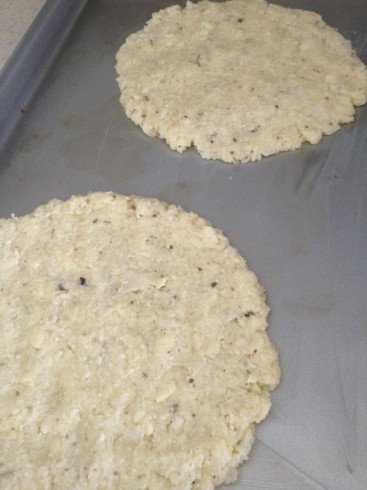
Mix everything together till well combined, form into pizza crusts (I did three small ones so I could flip them easily) on a very well greased baking pan. I greased it with butter, and it stuck a little bit…I’d recommend coconut oil for less sticking!
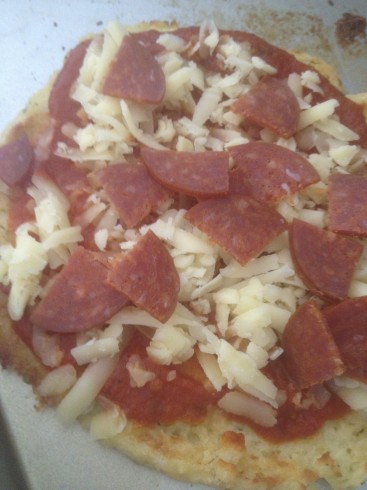
Bake at 350 until the bottom is browned (depends on your oven, probably 15-20 minutes or so). Flip the crusts and continue baking till the tops are golden. Remove from the oven, add toppings, and then put under the broiler till everything is warm and the cheese is melted.

The guests' verdict: “Amazing!”
What do you think? Do you dare try coconut flour and cauliflower in your pizza crust?
Are you adventurous in the kitchen?
Back in April, I wrote a post about the benefits of coconut flour and what you can do with it. This week, in my seminar for HW220: Contemporary Diet and Nutrition, my students and I had a discussion about this ingredient, and I told them I'd share another recipe.
I've made cauliflower pizza crusts many times (don't knock it till you try it!), but this time I decided to add coconut flour to it in hopes that it would make the crust a little more "bread-y." It worked! I tried this recipe out on some unsuspecting (standard American diet eating) guests...
Cauliflower Coconut Flour Pizza Crust
3/4 cup riced cauli (steam it, rice it—the best way is with a food processor, but you could use a grater)
3/4 cup shredded cheese (I used sharp cheddar)
1/4 cup parmesan cheese
2 eggs
2 Tbsp coconut flour
1 to 2 tsp pizza seasoning
add garlic and other flavors of your choice
Mix everything together till well combined, form into pizza crusts (I did three small ones so I could flip them easily) on a very well greased baking pan. I greased it with butter, and it stuck a little bit…I’d recommend coconut oil for less sticking!
Bake at 350 until the bottom is browned (depends on your oven, probably 15-20 minutes or so). Flip the crusts and continue baking till the tops are golden. Remove from the oven, add toppings, and then put under the broiler till everything is warm and the cheese is melted.
pre-baked crusts
Baked crusts, raw toppings...
Done! This could have used some veggies on top, but I'll just try that next time!
What do you think? Do you dare try coconut flour and cauliflower in your pizza crust?
Are you adventurous in the kitchen?


Monday, October 29, 2012
NOVA Sleep
11:28 AM |
Posted by
Kaplan Center for Health and Wellness
If you would like to explore this topic further, this NOVA
website has a variety of links to more interesting sleep research:
Sunday, October 28, 2012
Sleep, Dreams, and Memories
11:53 AM |
Posted by
Kaplan Center for Health and Wellness
Click here to watch this fascinating PBS video, where Dr Neil deGrasse Tyson explores
the connection between sleep, dreams, and memory:
Saturday, October 27, 2012
The Importance of Sleep
2:43 PM |
Posted by
Kaplan Center for Health and Wellness
Hi Everyone,
This week I’d like to share another UCSF video. In this
segment, Dr Ellen Hughes explores the importance of sleep and how it impacts
our health and wellness.
Nancy Silva, ND
Health Science Faculty
Tuesday, October 9, 2012
Birds of a Fitness Feather Part III: Flying Solo
10:10 AM |
Posted by
Kaplan Center for Health and Wellness

Years ago when I was a long distance runner I preferred to run alone primarily because I was slow and when I ran alone, I could run as slowly as I wanted. I found a run group whose members were also slow, and I liked them, but unless you too were slow, I wanted to run solo.
But then I started doing Crossfit. Crossfit scared the heck out me, it was totally unlike anything this runner had ever experienced and it was hard. Like really hard. So I recruited a buddy to go with me (birds of a feather and all) and she and I would plan our schedules so we could workout together. After a few months my buddy moved on, but that was okay because I had met new buddies with whom I could coordinate. My dependency on the buddy system was such that there were times when my buddies wouldn't show-up and even though I was already at the gym and ready to workout, I'd skip it. Yep, it was that bad.
After years of Crossfit, I began to drift toward powerlifting, which is where my ship has harbored today. Powerlifting, like Crossfit before, scared the heck out of me. Luckily for me, my husband is a powerlifter (what a coincidence!) and I began planning my training schedule around his training schedule. Like the buddies before him, if he couldn't train, I didn't train.
But then something happened. We moved. We moved to an Army post in the middle of nowhere (like all good Army posts are). I didn't have any buddies and my most important buddy, my husband, well his schedule and mine don't exactly mesh anymore. With a powerlifting tournament looming, not training wasn't an option. So I had to do something rather terrifying for this timid soul: I had to train alone.
I've been training alone for two months now and I have to be honest, it's been the best thing to happen to my training. Some of the benefits have been big and some have been more discrete. A few worth mentioning are:
1) I have become more aware of my form and technique. When you train with a partner or a coach, you receive feedback about what you're doing wrong (or right, but in my case, mostly wrong). Of course this is valuable information, especially for a novice. But since I am no longer a novice, I *should* be aware of my form and technique errors most of the time without coaching. And more importantly, I *should* be able to correct those errors myself. And now that I have to, I have. Training alone has forced me to be more self-aware and self-corrective.
2) I have more space to think and reflect. Like everyone, I have a lot of chatter in my mind. The inner monologue bounces all over the place and contains an endless loop of to-do-lists, grading rubrics, doctor's appointments, dinner recipes and random observations about foreign affairs. Sometimes my brain is exhausting! But an interesting thing has happened since I started training alone: the chatter quiets. Since I must now focus on my form and technique (see: above) and I don't have any distractions (like gossiping with my buddies) I am able to quiet my mind and enjoy the solitude. Training as meditation perhaps.
3) I am no longer afraid. I have always feared the back squat. I became less fearful by relying on a buddy who could spot me. But when it comes to squatting, you can safely do it alone if you do so in a rack. And this process scared me. What if I got stuck? What if I couldn't stand-up? What if I failed and people stared? Training alone showed me these things aren't a big deal. And more importantly, because I didn't want to get stuck, not stand-up or make a lot of noise by dropping the bar, I worked a heck of a lot harder in my squats than I ever did with a spotter.
4) I am a strong, capable woman. Sure, I knew I was fit before I had to train alone. But walking into a gym (a gym where you have no buddies) alone can be intimidating. But every time I walked into that gym, did my training, didn't need help, could quiet my mind, I left there with more confidence. And now, now when I walk in, I feel like Helen Reddy, "I am woman, hear me roar!"
In summary, there is a lot to learn about training. By identifying "experts", mirroring them and being mentored, you can take your training to the next level -- find an elite flock to fly with. But be sure to on occasion fly alone. Training solo is a way to learn something about yourself, your abilities and your limitations. Find a flock, then soar to your own heights.
Happy flying friends.
Posted by Rachel May
School of Health Sciences
Monday, October 8, 2012
Birds of a Fitness Feather Part II: Be a Product of Your Environment
9:35 AM |
Posted by
Kaplan Center for Health and Wellness

I won't bore you with my Oprah "ahh ha" moment, but I decided I didn't want to be fat anymore. I didn't want to feel bad, look bad and get winded when walking up a set of stairs in the parking garage.
At least for me (and many other friends I have spoken with) there is a natural shift that occurs when we begin to make fitness and our health a priority. For me, I had to distance myself from the fat friends I had who weren't interested in making changes. They kept eating out at the same greasy spoons, kept drinking beer too late on weeknights and kept sitting on their bigger backsides. For me, it was hard not to engage in those same behaviors when I was around them, so I had to spend less and less time with that group. If anyone is familiar with addiction counseling, this should sound familiar.
When I started working out, I joined a local gym. Over the course of a couple months I met some folks there who were in a similar boat -- they were trying to lose weight or get in better shape. We would chat at the gym, exchanged email addresses and then would make plans to meet at the gym or take a fitness class together. After a few months of exercise, I felt like I was capable of running (okay, jogging, slowly) a local 5K race. I did several of these and discovered that I saw a lot of the same people weekend after weekend. I started chatting with them at the starting lines. I learned about a run club that met several times a week nearby my house. I joined, I met more runners.
I think this is a natural progression for the fit-minded person: Start working-out, stop spending time as much time with people who don't, meet people who do what you do, spend more time with them. But while meeting new friends is great, I think we can create an even more contagious environment by seeking out environments and people who challenge us.
If you want to progress in your fitness you must (by definition) overload your body -- do different activities, do heavier things, do higher intensities. In my experience, the best way to accomplish these things is to find people that will expose you to different activities, will educate you, will encourage you and most importantly, will inspire you. So rather than finding the group of folks who look like you, here's what I recommend:
1) Shop Around: Joining a new gym, class or group? Look for the folks you want to look like. I've moved around quite a bit recently and when I start shopping for a gym, I join the place that scares the heck out of me. If I walk in and am intimidated by the heavy weights, hard training and hot bodies, that's the gym for me.
2) Find People Who Make You Feel Dumb: Not really, don't hang out with people who tell you you're an iditot (unless you like that), but do seek out and train with people who know a lot more about training than you do (then marry one, like I did). When it comes to fitness, learning new techniques, movements and programs is key to progress. Ask questions. Most fitness-minded people like nothing more than talking about fitness. I have to yet to meet anyone who didn't answer my question about their training and suggestions for progression. If anything, they usually talk too much.
3) Get a Role Model: When I first started training Crossfit and then powerlifting, I attached myself to the hips of the women who were the best in the area. The women who lifted heavy things, who crushed my times and who had years of experience. In my opinion, if you aspire to be like someone, you should be around that person. Everyone needs a mentor. I bet you have one at work, but do you have one for your workouts?
I think all of us have a natural tendency to want to associate with people who look like us and perform at the same level we do -- we want to "fit in". We don't want to be the least fit, the least fast or the least strong. But when we are looking for a training environment, we want to fight those urges. Find the place and the people who intimidate you. Train there. Make friends there. Become a product of that environment.
Posted by Rachel May
School of Health Sciences
Friday, October 5, 2012
Birds of a Fitness Feather Part I: Can Fitness Be Contagious?
12:35 PM |
Posted by
Kaplan Center for Health and Wellness

This idea really resonated with me. If we associate with people who are overweight, make poor food choices and are physically inactive, doesn't it just make sense that we would be more likely to be overweight, eat garbage and sit on our backsides? Modeling theory in psychology is based on the principle that people learn behaviors by watching and then imitating other's behaviors and that behaviors can be changed (ideally, for the better) by modeling behaviors in other people.
Nearly 70% of American adults are overweight or obese, less than 50% of us are getting the recommended amount of exercise; I heard David Katz, MD refer to the current American landscape as a "toxic environment" and certainly with numbers like these, it would be hard to disagree. So if obesity and related behaviors have a social contagion element, this could be Bad News Bears for our collective health.
But we can use the social contagion effect to our advantage when it comes to fitness by surrounding ourselves with fit people who are dedicated to exercise and healthy behaviors. In the upcoming blog posts I'll share my thoughts on how to identify (or create) a contagious environment and find especially infectious people. I bet you never considered that surrounding yourself with infectious contagious people would be good for your health, did you?
Posted by Rachel May
School of Health Sciences
Subscribe to:
Posts (Atom)